What Are The Most Common Challenges of International SEO?
Most ecommerce brands that come to us having already attempted international SEO share one thing in common: they did not know what they did not know.

 SEO
SEO
 Packages
 Google Ads
 Company
 Sectors
 Site Performance
 Locations
Most ecommerce brands that come to us having already attempted international SEO share one thing in common: they did not know what they did not know.
The technical decisions looked straightforward on paper. The content seemed close enough. The hreflang tags were added. And yet rankings in target markets stayed flat, or worse, the existing home market rankings took damage they did not see coming.
At Searchflex, we work with D2C brands across fashion, jewellery, skincare, home and garden and more who are scaling beyond domestic markets into the UK, US, Australia, UAE, and Europe.
International SEO sits at the core of our work – not as a bolt-on, but as a foundational infrastructure problem. We have seen the same challenges repeat across clients, and the ones that cost brands the most are almost never the ones they anticipated.
Here is an honest breakdown of what actually goes wrong.
Yes – and it is the one decision that is hardest to undo once made. Before a single piece of international content is published, the structure of the site determines how authority accumulates, how search engines interpret geographic signals, and how much technical overhead the team will carry indefinitely.
The three structures are ccTLDs (example.de, example.fr), subdirectories (example.com/de/, example.com/fr/), and subdomains (de.example.com). Each comes with genuine trade-offs, not just preference differences.

Nike uses country-specific subdirectories to support international SEO targeting.
ccTLDs send the strongest country signal and are right for brands making a fully resourced, long-term commitment to a specific market. The cost is significant: each ccTLD is an independent domain with zero inherited authority. Link-building, content, and technical SEO must be started from scratch in every market. For most ecommerce brands, this is prohibitive unless they have separate regional marketing budgets.
Subdirectories consolidate all link equity under the root domain and are far easier to manage operationally. This is the structure we implement most consistently for our clients, particularly those targeting multiple English-speaking markets simultaneously. The authority earned by your .com carries into /au/, /us/, and /uk/ – which accelerates ranking in new markets rather than forcing you to rebuild.
Subdomains sit in the middle but lean toward the wrong side for most brands: they can dilute authority, they require separate crawl budgets to be treated well by search engines, and they offer no meaningful advantage over subdirectories for the majority of use cases.
The financial cost of getting this wrong is real. Brands that build on subdomains and later migrate to subdirectories typically experience months of ranking volatility. Those attempting ccTLD migrations often see significant traffic loss during the transition, even with correctly implemented redirects.
Hreflang is the attribute that tells Google which version of a page to serve to users in a specific language or region. It is logical in concept and consistently error-prone in practice. In our experience auditing international sites, partial or broken hreflang implementations are more common than correct ones.
The most prevalent error is missing reciprocal annotations. Every regional URL in a hreflang cluster must reference every other URL in that cluster, including itself. A UK page that references its Australian and US counterparts is useless if the Australian page does not return the reference. A single missing annotation across a large catalogue of pages is enough for Google to treat the entire implementation as unreliable and ignore it.
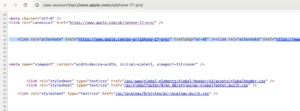
Example of hreflang annotations used to signal language and regional targeting to search engines.
Language code errors are widespread. Using “uk” for Great Britain is one of the most common – the correct value is “gb.” Attempting to target regions rather than country-language combinations (trying to use hreflang for “Europe” as a region, for example) simply does not work.
The more damaging scenario involves canonical tags. When a canonical tag accidentally designates the same URL as the preferred version across every regional variant, hreflang becomes entirely redundant. We see this most frequently on sites where the technical SEO and content management workflows are not aligned – different teams making changes without awareness of each other’s configurations.
One important correction to a widespread misconception: hreflang does not solve duplicate content. It tells Google which page to serve to which audience. It does not cause Google to treat near-identical pages as distinct pieces of content. These are two separate problems, and confusing them leads to under-investment in actual content differentiation.
Same-language, multi-country targeting is the hardest duplicate content scenario in international SEO – and the one most competitors’ content glosses over. Translating from English to French carries no duplicate content risk. Targeting UK and Australian English audiences with near-identical content on the same domain does.
When the same content exists across /uk/ and /au/ with minor variations (price formats, perhaps a few localised terms), search engines face a genuine ambiguity problem. Google consolidates these pages and picks one to rank – often not the version you intend, and rarely with the geographic specificity you need. Link equity fragments across multiple URLs instead of compounding behind one authoritative version.
Genuine localisation is the only solution. For a jewellery brand targeting both the UK and Australia, the content across those regional versions needs to reflect meaningfully different contexts: different search behaviour, different cultural references, different competitive landscape, different purchasing signals. When we worked with PRYA – a leading women’s jewellery brand – on a Shopify migration with full international SEO integration, their international keyword visibility grew by 83% within three months of launch. That result required properly structured, localised content from the ground up. Copied pages with hreflang tags would not have moved the needle.
For ecommerce brands with large catalogues, this challenge multiplies. Product descriptions replicated across regional storefronts without meaningful variation are a consistent source of duplicate content issues and a primary target in every international SEO audit we conduct.
It does not – and assuming otherwise leaves significant organic traffic on the table. Search behaviour is shaped by local idiom, purchasing context, and cultural convention. The same product is searched differently across English-speaking markets in ways that are not always intuitive.
“Trainers” in the UK is “sneakers” in the US. “Solicitor” in the UK is “attorney” in the US. A D2C skincare brand ranking strongly on “SPF moisturiser” in the UK will likely miss volume in Australia, where the more common search is “sunscreen moisturiser.” These are not marginal differences – they represent distinct keyword pools with different search volumes, different competition levels, and different intent signals.
Every target market requires its own keyword research pass, using geo-filtered data and, wherever possible, validated against how users in that market actually phrase their queries. For non-English markets, machine-generated keyword lists are a starting point, not a finished brief. A keyword list generated without native-speaker input will consistently miss the idiomatic searches that drive the most qualified traffic.
Translation converts words. Localisation adapts the entire experience, and the distinction has direct ranking implications because search engines evaluate content quality through engagement signals.
Localised content reflects local cultural references, local competitors, local idiom, local pricing formats, and local regulatory context. A D2C brand entering the UAE market, for example, needs to account for cultural norms around imagery and messaging that differ materially from their UK or Australian content. A fashion brand targeting Germany should know that German consumers have notably different expectations around return policies, and that content addressing those expectations performs better than identical copy that does not.
Content that has been translated without localisation creates friction. Users encounter phrasing that feels slightly off, examples that are culturally unfamiliar, and references that do not land. Bounce rates rise. Dwell time falls. These engagement signals feed directly into rankings – and they are one reason why brands with technically correct international setups still fail to rank competitively in target markets.
This is where the gap between intention and execution is widest, consistently. Brands that invest carefully in technical implementation and content often treat local link building as secondary, and then cannot explain why rankings in new markets are not responding.
The reason is straightforward: backlinks from locally relevant, authoritative websites in a target market carry more weight for ranking in that region than additional links from the home market. A UK brand targeting Germany needs backlinks from trusted German publications, trade bodies, and niche directories. Earning those links requires local market knowledge, outreach in the relevant language, and content that gives German publishers a genuine reason to link.
This is resource-intensive. It requires relationships that take time to build. It cannot be compressed into a few months of outreach. And it is why brands that want to rank seriously in multiple markets need to treat link building as a per-market investment, not a single shared programme.
For ccTLD deployments, this is even more acute: each domain must build its authority entirely independently, which means four markets require four concurrent link-building programmes.
Yes, and they rarely get coverage in generic international SEO guides. Ecommerce sites carry structural complexities that amplify international SEO challenges in ways that apply less to lead generation or content-only sites.
Faceted navigation is a significant source of international crawl budget waste. Filtering parameters that generate thousands of crawlable URLs in a domestic market multiply across regional subdirectories, creating an exponential crawl and indexation problem. This needs to be resolved at the technical level before international expansion – not after.
Shopify’s URL structure creates specific constraints for international SEO. Shopify Markets and its subfolder approach for international targeting has known limitations around hreflang implementation, canonical handling, and how the platform manages alternate regional URLs. Brands that attempt to retrofit international SEO onto a Shopify build without understanding these platform-specific constraints regularly encounter implementation errors that are difficult to diagnose without hands-on platform experience.
Internal linking architecture is frequently overlooked as an international signal. How pages link to each other within a regional subdirectory affects how crawl equity is distributed across that version of the site. Thin internal linking to regional pages, a common outcome when international sections are built as a secondary priority, creates weak crawl paths that slow indexation and suppress rankings.
This is a question brands consistently underestimate, and the answer matters for setting realistic expectations and maintaining investment through the lag period.
For a new international subdirectory on an established domain, initial indexation should occur within weeks. Meaningful ranking movement typically begins between three and six months post-launch, assuming the implementation is correct. For ccTLDs starting from zero authority, the timeline extends considerably, twelve months before consistent rankings in competitive categories is a reasonable expectation.
Hreflang signals take time to process. Google has confirmed that hreflang processing does not happen immediately on crawl, it occurs during indexation, and for large sites with complex regional structures, full processing can take several months. Brands that expect immediate ranking movement in new markets after a launch often pull investment too early, before the signals have had time to be processed and reflected in rankings.
The consistent differentiator across the brands we work with is infrastructure quality, not budget. Brands that rank globally have made correct architectural decisions from the start, implemented hreflang without errors, produced genuinely localised content market by market, and committed to building local authority through targeted link acquisition.
None of the challenges above are insurmountable. All of them require precision and coordination that ad hoc international expansion rarely delivers.
If your brand is scaling into new markets and organic visibility is not following, these issues are almost certainly part of the picture. Our international SEO service is built specifically for ecommerce brands navigating this complexity, with experience across fashion, jewellery, skincare, home and garden, and D2C brands scaling from the UK into global markets. Get in touch to talk through where the gaps are.