Best SEO Strategies For Skincare Cosmetics Brands
The skincare, beauty, and cosmetics industry is competitive, saturated, and heavily influenced by search behaviour.

 SEO
SEO
 Packages
 Google Ads
 Company
 Sectors
 Site Performance
 Locations
The skincare, beauty, and cosmetics industry is competitive, saturated, and heavily influenced by search behaviour.
Customers regularly research ingredients, compare products, read reviews, and look for solutions before purchasing. If your brand is not visible during these searches, you are missing high-intent traffic that converts into real revenue.
The best SEO for skincare brands focuses on search intent, product education, and long-term authority. SEO for skincare isn’t about chasing trends. It is about building structured visibility that supports every stage of your conversion funnel – from initial discovery and consideration to purchase and long-term customer retention.
Skincare buyers rarely search using brand names at the start. They search for solutions. Queries like ‘best serum for acne scars’ or ‘moisturiser for sensitive skin’ reflect clear intent.
Your keyword strategy should focus on these problem-based searches. Map each concern to relevant product pages and supporting SEO content. This approach aligns with how customers think and increases the likelihood of conversions.
Avoid stuffing keywords unnaturally. Instead, structure content so that it answers specific questions clearly. Search engines reward relevance and depth. Users reward clarity.
Product pages should do more than describe features. They must educate, persuade, and demonstrate E-E-A-T whilst at the same time remaining optimised for search engines.
Include detailed descriptions of ingredients, benefits, usage instructions, and suitability for different skin types. Add correctly structured SEO headings to improve readability. Use internal links to guide users to related products or educational guides.
For brands investing in ecommerce SEO, technical SEO optimisation is equally important. Clean hierarchy and URL structures, fast loading speeds, schema markup, and optimised images improve rankings and user experience.
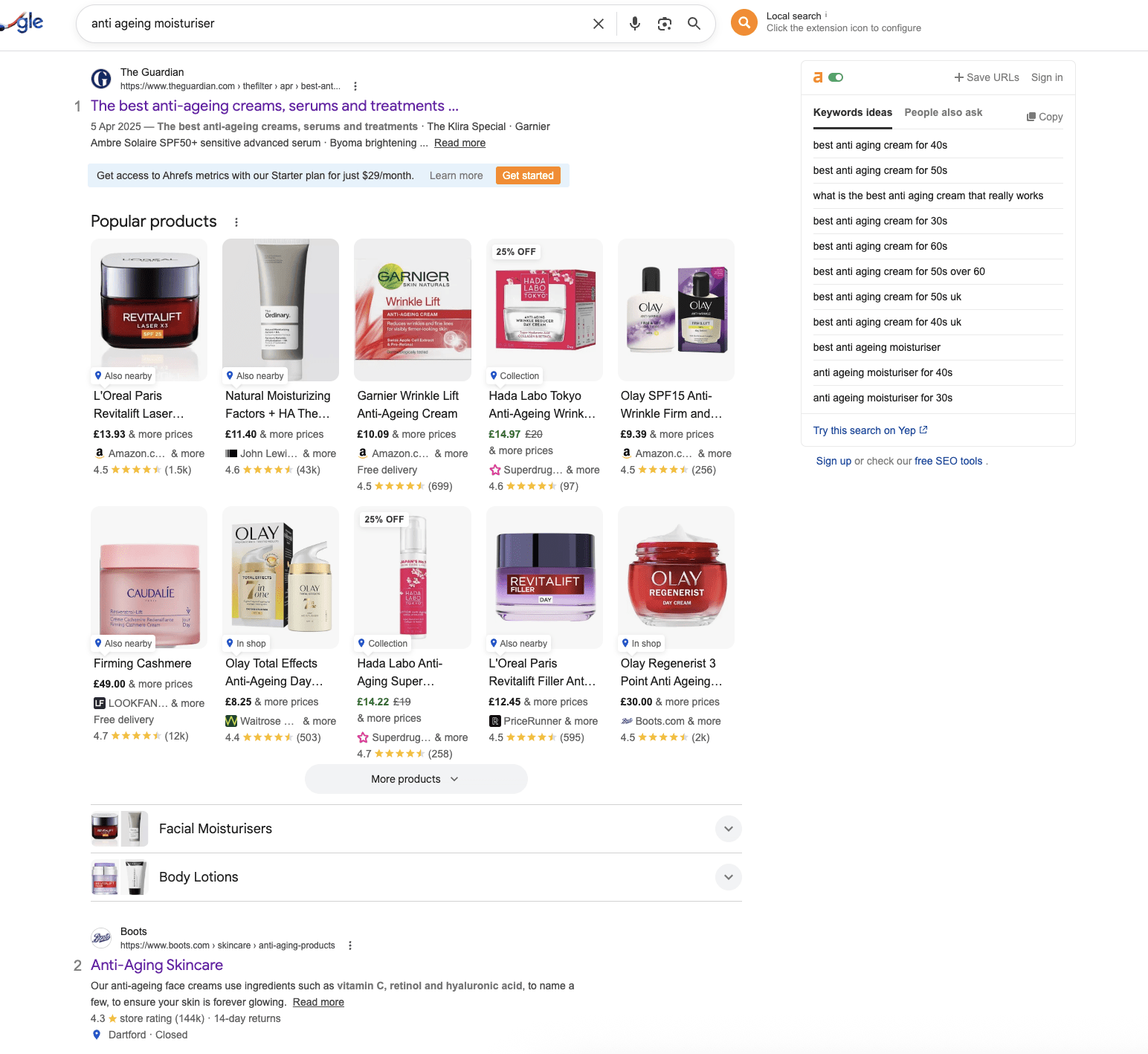
Google results for “anti-ageing moisturiser” show review content, popular product carousels, and ecommerce category pages.
When searching for “anti-ageing moisturiser,” the results page reveals mixed search intent. The #1 ranking result is a review article from The Guardian outlining the best anti-ageing creams. Beneath this, Google displays a product carousel featuring popular moisturisers from multiple retailers. The first ecommerce category page (Boots) appears further down.
This indicates informational, commercial, and transactional intent – to win at SEO in makeup, beauty, and cosmetics – you need to cover the whole spectrum, and use clever internal linking tactics to build relationships between the pages in your SEO content strategy.
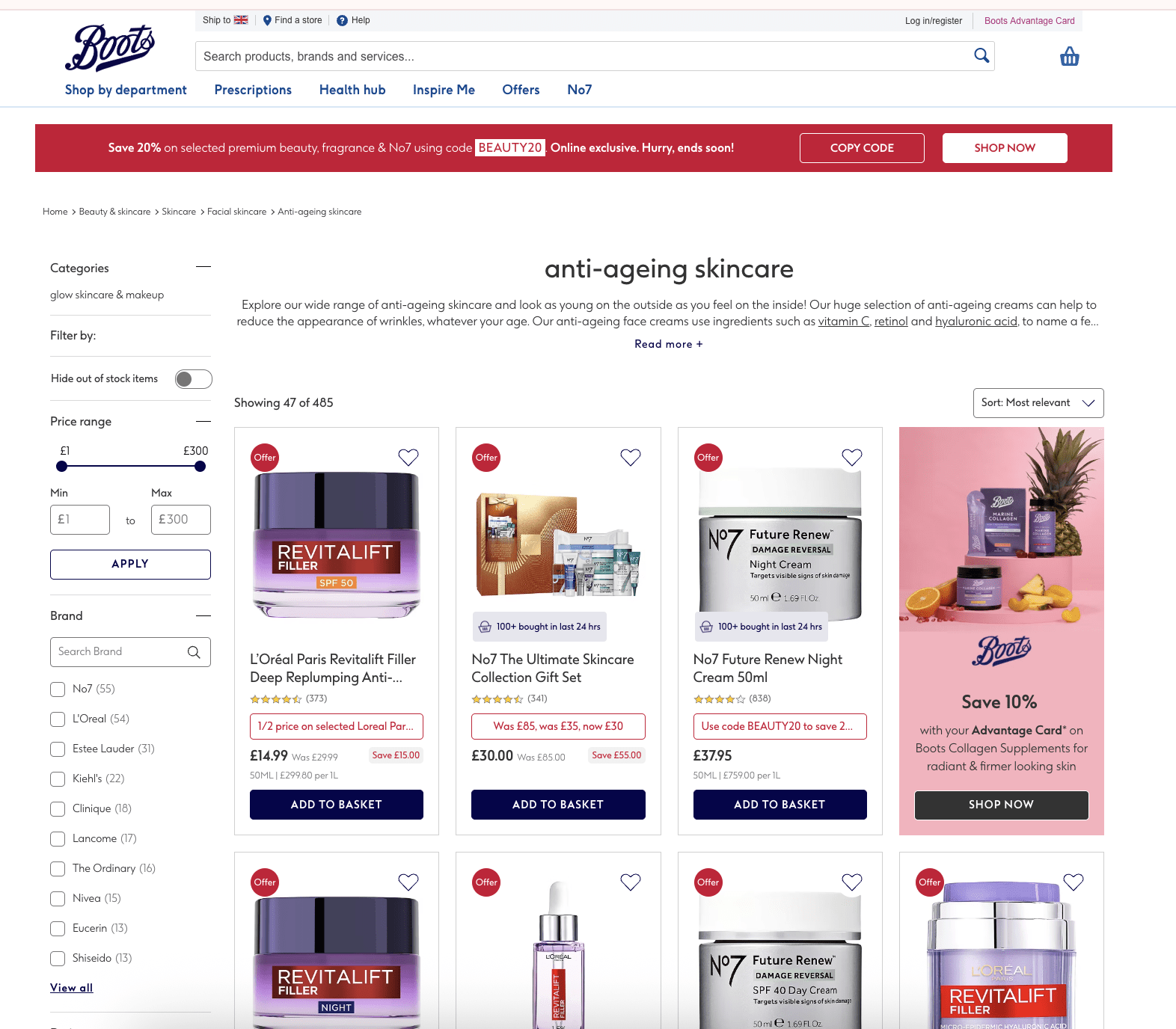
Boots Anti-Ageing Skincare category page ranking organically for “anti ageing moisturiser.”
Boots ranks with a well-optimised category page targeting anti-ageing skincare. The page includes a well-structured breadcrumb, which provides equity to other relevant areas of the catalogue, keyword-aligned headings, introductory SEO copy, internal product linking, filters, and strong commercial signals such as pricing and reviews.
High-quality images and user-generated content also support conversions. Reviews that mention specific skin concerns strengthen keyword relevance naturally.
But where could Boots improve? There are a few opportunities that haven’t been taken advantage of – such as internal linking ‘pills’ to other relevant collections (example below)
And also – providing additional context for this collection with accordion content that sits below products (see below). This is a clever tactic for AI ecommerce SEO – as you can closer match search intent from a conversational search perspective.
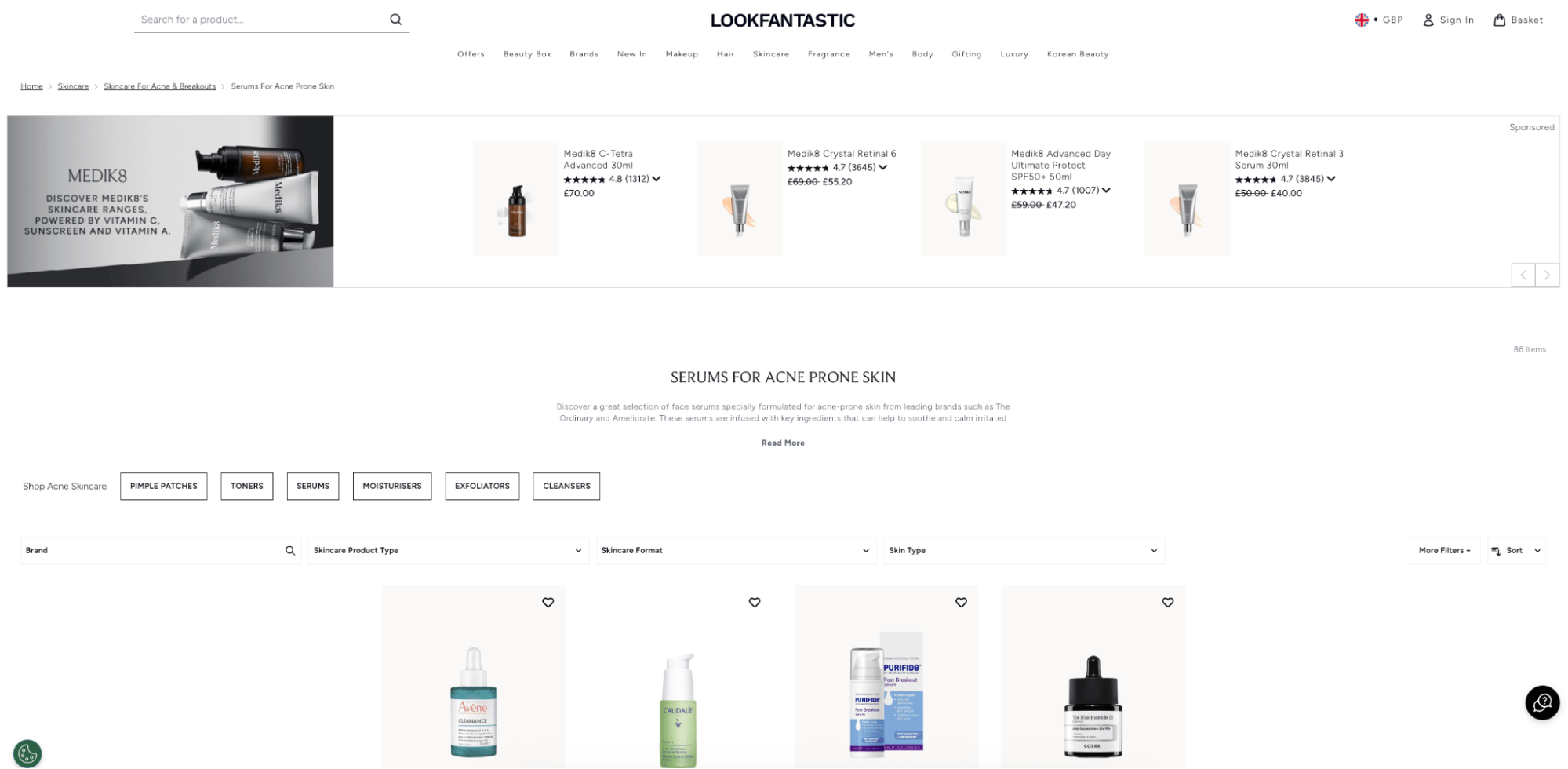
Ingredient-focused content performs strongly in the skincare space. Consumers want to understand what they are applying to their skin.
Create dedicated guides, interactive pages, or blogs explaining ingredients such as retinol, niacinamide, or hyaluronic acid. Cover benefits, side effects, and suitability. Link these guides to relevant product and collection pages to create a structured content ecosystem.
Beyond written content, interactive tools can further strengthen authority. For example, AlumierMD’s skincare quiz helps users identify the right products based on their skin concerns. Tools like this demonstrate expertise, personalise the user journey, and reinforce trust. All of these contribute to stronger brand authority signals.
This strategy positions your brand as a trusted source rather than just a seller. Over time, search engines associate your site with topical authority in skincare.
Educational SEO content also captures early-stage users who may convert later through remarketing or email campaigns. This ensures your entire conversion ecosystem is attracting more of your ICPs.
Backlinks remain one of the strongest ranking signals. For skincare brands, relevance matters more than volume.
Collaborate with beauty bloggers, skincare experts, and industry publications. Provide expert commentary or contribute educational content. Quality backlinks from trusted sources improve domain authority and visibility.
Digital PR campaigns around product launches or research insights can also generate organic coverage. Focus on long-term relationships rather than one-off placements.
Skincare is highly visual. Many users search through images or video platforms before purchasing.
Optimise images for SEO with descriptive alt text and compressed file sizes. Use structured data where possible. Create short educational videos and host them on platforms that support discoverability.
Embedding videos on product or blog pages increases time on site and supports engagement signals.
Some skincare brands operate locally through clinics or retail stores. Others sell internationally online. Some do both. Your Local or International SEO structure should reflect your business model.
Local brands should optimise for geographic keywords and maintain consistent Local SEO listings across directories. Encourage customer reviews to build trust and improve visibility in map results.
Online first brands should focus on international keyword research and consider localisation strategies if targeting multiple regions.
Clear site architecture ensures search engines understand your priority markets and products.
For those that don’t know what E-E-A-T is in ecommerce, search engines prioritise content that demonstrates Experience, Expertise, Authoritativeness, and Trust. For skincare brands, this applies across your entire site – most importantly, product pages, category pages, and editorial content.
Ensure ingredient claims are supported by evidence. Include clear product usage guidance. Showcase reviews, certifications, clinical references where relevant, and transparent brand information.
E-E-A-T should not sit within a single blog post. It must be implemented at a sitewide level, including product templates, category pages, educational articles, and supporting content – particularly since one of Google’s latest core updates as of December 2025.
AI-driven search and intent-based results increasingly rely on structured understanding rather than simple keyword matching.
Schema markup is critical. Product schema, FAQ schema, Review schema, and breadcrumb schema help search engines interpret content context accurately. This improves eligibility for rich results and AI-generated summaries.
Intent-based keyword targeting is equally important. Content should align with informational, commercial, and transactional queries across the entire site architecture, not just individual pages.
Ecommmerce SEO for AI search must be implemented at a sitewide level across product pages, category pages, blog articles, and technical infrastructure.
Technical SEO underpins every visibility strategy. Without clean architecture, crawlability, and performance optimisation, even strong content will struggle to rank.
It ensures search engines can efficiently crawl, interpret, and prioritise your content.
SEO for skincare, makeup, beauty, and cosmetics is not static. Consumer trends change, ingredients rise in popularity, and search demand shifts seasonally.
Monitor rankings, traffic sources, and conversion data regularly. Identify which content drives revenue rather than just visits. Optimise underperforming pages with updated information and stronger internal links.
Consistent analysis ensures your strategy remains aligned with real customer behaviour.
If your skincare brand wants structured growth through organic search, Searchflex delivers tailored Ecommerce SEO services designed to increase qualified traffic and drive measurable sales. Our expertise spans SEO for skincare brands, skincare ecommerce optimisation, and performance-led digital marketing for beauty and cosmetics. Speak with our team today and build long-term visibility that supports sustainable brand growth.